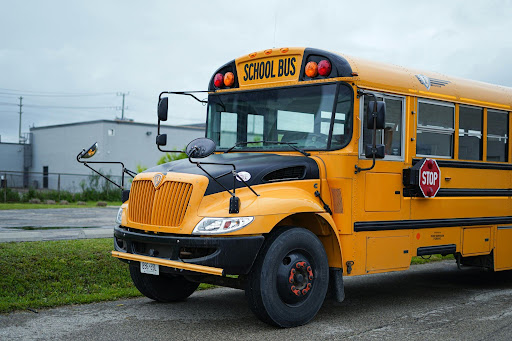

Since 1635, when the first public Boston Latin School was founded, the school system hasn’t changed. For almost 400 years students have been forced into the repetitive routine of life where it seems that the only path to success is linear; graduate high school, go to college, then get a job. The school system has not changed, but students have.

The above shows a photo of a wall-mounted telephone, and beside it, a new iPhone. Significant changes were made to the original telephone.

The above shows an old car that was made in the 19th century, and beside it, a new car made in 2025. Cars have changed a tremendous amount since the first one was invented.
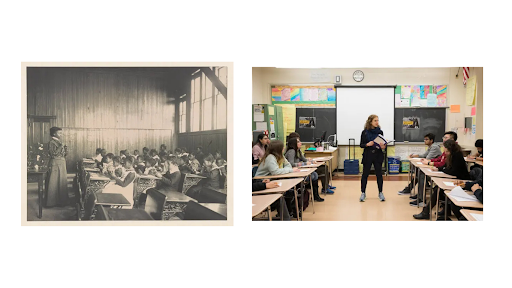
The above shows an old classroom on the left, and then on the right, today’s standard classroom, with barely any differences.
Important life necessities, including cars and phones, have evolved into new inventions that humans today use and understand, while the standard classroom where a child spends almost their whole childhood has stayed the same.
Humans are a changing species, and as individuals evolve, new ideas are used and created, yet the school system has not changed.
The fact that traditional schooling hasn’t changed in almost 400 years proves the weakness of the system.
The Mentally Draining Loop
Every day, students have to sit in a classroom for over 7 hours while they get overloaded with information.
When asked the question, “Do you ever feel like school drains you?”, Maisie Costello, a sophomore at Pentucket Regional High School, says, “Yes, it’s such a harsh environment, and there is not much motivation to go. Frequently, I have loads of work, and it overwhelms me.”
Another sophomore, Hailey Caddigan, talks about how school controls her life: “Yes, between after-school activities and constant homework, it feels like you can never catch a break. Whenever I’m doing something un-school related, it is always in the back of my mind because it’s something that I have to get done.”
Liah Bedard, another sophomore at Pentucket Regional High School, says, “Yes, the overcrowded classrooms and the standardized testing narrow my critical thinking skills. It feels like a never-ending cycle, and the only way to succeed in life is to go through at least 16 years of schooling.”
Students are forced into a system and told that it’s important because it’s how they make their lives meaningful.
Students repeat almost the same routine for 180 days a year.
Wake up at six in the morning every day.
Sit for hours and listen to their teacher’s lecture.
Study for upcoming exams.
Stay up till eleven to complete their homework.
The loop feels endless, and it is destroying kids’ creativity and motivation to have the privilege of getting an education.
It is truly devastating that our future still depends on a system that was developed centuries ago, and that no longer reflects how students learn or think.
The school system has not evolved, but students have.
The Consequences of an Outdated School System
Students get lectured by teachers and take notes to prepare for assessments, which forces their learning into a teacher-based approach. This limits students’ education because they are forced into absorbing information rather than actively participating when learning.
Over time, when students are in a cycle of not asking questions, exploring new ideas, or challenging themselves, it creates a loop where they are forced to maintain consistency and only follow authority.
Another big issue is the irrelevant subject matter. Students must take subjects in high school that are irrelevant to their future goals.
In addition, traditional subjects do not apply to the success of the modern workforce. This makes students unprepared for the real world.
Mental Health is also a rising issue in teenagers, and the competitive school environment makes students’ stress levels rise.
School harshly enforces good academic performance, participation in extracurricular activities, and a good attitude. This environment makes students overwhelmed and unable to cope with their mental health.
The school system’s inability to adapt to students’ mental health pushes students to disengage, leaving them unmotivated and not connected to the learning.
To sum it up, the school system is in need of an urgent change. The unevolving system is failing the students who it claims to help. Prioritizing old standards over new, effective ways of learning pushes students into burnout and disengagement.
If we want our new upcoming generation to be creative, motivated, and prepared for the real world, the system needs to change immediately. Students have evolved, and it’s finally time for the outdated school system to do the same.