

On July 20, 1969, Neil Armstrong was the first man to walk on the moon. Neil Armstrong was sent to the moon on NASA’s Saturn V rocket during the Apollo 11 mission. Since this landing, many other NASA astronauts and other space organizations have gone into space. However, the last astronaut to walk on the moon was Gene Cernan in 1972. After this mission, no human has been on the moon to this day.
Why Did We Stop?
Since the landing in 1972, people have been asking the same question: “Why did we stop?” The answer to this question is due to high cost, political will, and overall a shift in priorities. The reason why we sent Neil Armstrong to the moon in the first place was to win the Space Race against the Soviet Union. Since then, the U.S. has had no conflict with other nations where going to the moon would benefit the country, so NASA has had no need to go back to the moon. Although things are changing once more, NASA is preparing missions to send astronauts back to the moon.
Artemis
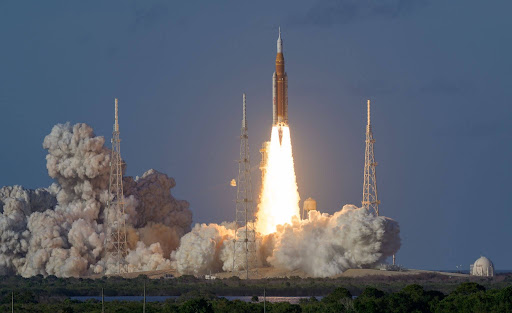
In late 2017, NASA established the Artemis program, with the goal of returning humans to the lunar surface. Recently, NASA launched the Artemis II rocket to do a lunar flyby around the moon to serve as the first of many milestones on deeper space travel. A representative from NASA explained the Artemis mission by saying, “We’re going back to the moon for scientific discovery, economic benefits, and inspiration for a new generation of explorers.”
Next Step
Landing on the moon is only the first of many steps in NASA’s Artemis program. NASA is planning to build a full lunar base on the moon for scientific research by the early 2030s. With the help of the lunar base, NASA’s intentions are to send astronauts to Mars for the first time in history. This would be revolutionary for human achievement because sending astronauts to Mars will not only be the farthest any human has ever been in space before, but also the first time humans would be on a different planet. When asking a fellow classmate at Pentucket, Jackson Nolte, his opinion on this plan, he stated, “I think that’s a brilliant idea to have a checkpoint between the Earth and Mars, with a base on the moon. This plan could be extremely beneficial to our society.”
Colonization
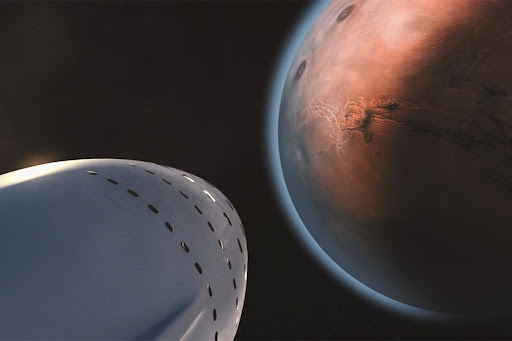
Once humans reach Mars, NASA plans to start populating the planet for long-term human survival beyond Earth. When asking one of Pentucket’s brilliant science teachers, Mr. Soule, about his beliefs on the future colonisation of Mars, he proclaimed, “It would be extremely beneficial to our understanding of our solar system, and the study of physics. However, I believe we should focus more on the issues of our own society first, rather than sending humans to other bodies.”
Similar to this, when asking Scott Chicarello, another student at this school, his thoughts on NASA’s plans, he said, “Future colonization of Mars could have some pros and cons to it, but I do believe we should continue exploring other planets around us for the possibility of one day inhabiting them if Earth is no longer suitable for human life.” Both of these representatives from Pentucket show the overall beliefs most people have about the Artemis program.
Economics
NASA’s out-of-this-world plans to colonize Mars will not be cheap. Though we do not know the exact price of the whole Artemis program, we can assume that it will be extremely expensive. The recent Artemis II mission that was launched to do a lunar flyby, cost over 4 billion dollars in government funding. In addition to this, NASA’s plans to build a base on the moon is estimated to cost over 20 billion dollars in funding to build. Both these examples are just the tip of the iceberg for all the other missions NASA will have to embark on if they want to be successful with its future desires. Nevertheless, the U.S. government plans to continue funding the Artemis program for future scientific research, and to have a full-time American presence outside of Earth.
To Infinity and Beyond
Ultimately, the idea of a civilization outside of the Blue Planet is not too hard to imagine anymore. With NASA’s Artemis program, the moon, Mars, and other areas in our galaxy may one day be your home.