Recent History –
Over the last few years, the United States Men’s National Team has had some of its lowest times of recent memory, and some of its best wins. From continental success to group stage exits to countries with a 75th of our population to our recent unbeaten run against stiff opposition, this article will detail the past, present, and future of our national team.
The recent history of the national team has been tumultuous, to say the least. It would be best to start at the appointment of Gregg Berhalter as manager of the national team in 2018. The start of Berhalter’s tenure was very promising, with him leading the team to 4 wins in his first four games. These wins would set the tone for a strong team, ready to take hold of North America as a top 20 team in the world.
Berhalter’s first major trophy with the team was the 2021 CONCACAF Gold Cup, with a 1-0 victory over continental rivals Mexico in extra time. The run to the final was relatively easy, with the United States cruising through the group stage and winning all elimination matches 1-0. While not the most convincing display, it was a good view of a promising team leading into the 2022 World Cup being held in Qatar.
That World Cup proved to be a good showing for the United States, with star player Christian Pulisic leading the team to a round of 16 finish, losing 3-1 against the Netherlands. While not the greatest result regardless, given the sparse success of the United States in previous World Cups, it was viewed as a good finish.
Cracks in the team started to show in the 2023 CONCACAF Gold Cup, with what was supposed to be a strong team going out to Panama in the semis, losing 4-5 on penalties after a 1-1 draw. It didn’t help that the team was rotating managers quickly, with Berhalter’s contract running out just after the World Cup, two successive interim managers were appointed previously to Berhalter’s reappointment before the aforementioned Gold Cup.
These cracks in the team slowly manifested into gaping holes when the United States began the Copa America, the tournament for North and South American nations, with a limp showing to get eliminated in the group stage, suffering 2 losses and 1 win, that win being against one of South America’s worst teams, Bolivia. The most embarrassing loss was against Panama, who beat us 2-1 yet again. The national team had come to a new low under Berhalter, not even making it through to the knockout stages.
This was a major turning point for the team, with many calling for Berhalter to be sacked, which he was on July 10th, 2024. Many names circulated, but eventually the United States settled on Mauricio Pochettino, former Chelsea FC and Tottenham Hotspur manager. The Argentine’s first matches were a series of ups and downs. He took charge before the North American Nations League, but failed to lead the US to any silverware, falling short in the Semis to Panama yet again and losing to Canada in the third place match.
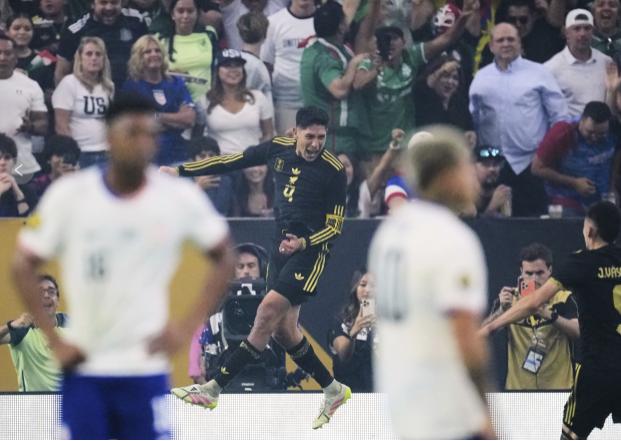
Many reactionary fans were calling for Pochettino’s head already, with friendly matches also showing a disjointed team without a clear identity or chemistry. It was refreshing to see a deeper run by the states in the 2025 CONCACAF Gold Cup, but we were dispatched in the final by a strong Mexico side 2-1.
The ensuing friendly match against South Korea ended 2-0 to Korea, with that being the last match the national team has lost. Strong showings against Japan (2-0), Ecuador (1-1), Australia (2-1), Paraguay (2-1), and especially Uruguay (5-1) have reinvigorated the national team in this stretch of matches before the World Cup, hosted mostly in the United States.
Where To Next? –
Personally, I think the United States has the ability to go far in the 2026 World Cup, and that sentiment is echoed by many of my peers. Sophomore Philippe Lombart believes that “the United States will probably go out in the Quarterfinals or Semis” and he thinks that the appointment of Pochettino as coach was “Great, I think he’s a good coach and I can already see the United States improving,”
Sophomore Alex Denley had similar ideas, saying “I think we have had high hopes and always failed to reach them, but with a new team and a younger squad…I think we’re gonna be good.” However, he does have qualms with Pochettino’s appointment: “Not my favorite guy, gonna be honest. I don’t like his formation, I don’t like his style, but I think he deserves a chance with this World Cup,” and that he thinks we can go at least to the quarters or semifinals.
When asked about the World Cup’s environment and whether it’ll be better for the United States on home soil with home advantage or more difficult to live up to expectations, Alex and Philippe had similar things to say about the team being stronger with home advantage and fans backing them. On the other hand, English teacher Ms. Ducolon believes that it may be harder to compete against “some of the really really excellent European teams,” and she wonders whether being on home turf and being “Not evenly matched, and if you’re not able to compete on your home turf, is it even more crushing and do you lose your ability to keep going?”
While both sides of the argument are valid, I can only see this team on an upwards trajectory. Without going too in depth into tactics, I’d like to highlight one thing that the USMNT are truly exceptional at. It’s not technical prowess, or game sense, or tactical elegance, it’s our passion. We play our hearts out every game. The recent 5-1 win against Uruguay exemplifies this. The pressing and tirelessness we exhibited led us to that win, with young players jostling to prove themselves in the prelude to the World Cup.
If we can keep this strong team spirit and philosophy alive, I truly think we can go far in the World Cup. It’s the perfect storm, really. A World Cup on home soil, a golden generation in full swing, a group of players eager to prove themselves, and the knowledge that the United States can truly go far in this competition. Now all US soccer fans can do is wait, with baited breath, to see if we can snatch this opportunity, or fall short like we have in years past.