
A few weeks ago, when preparing with my group for an APUSH debate, I mentioned logical fallacies. One person in my group understood what I was talking about, but the rest had never heard of a logical fallacy before. In a somewhat humorous way, “logical fallacies” became sort of a buzzword in that class for the next few days.
Although that was just a funny one-off incident, it got me thinking: “How many of Pentucket’s students know little about rhetoric beyond ethos, pathos, and logos?”
When asked the question, “Do you know what a logical fallacy is and can you give me an example?” This is how Pentucket students answered:
First, here is how a senior who has taken AP Psychology, AP Language and Composition—a class which discusses rhetoric—AP US History, and is now taking AP Literature and AP US Government and Politics explains it: “A logical fallacy I believe is when—(…)—let’s say you were trying to prove your point in an argument so you throw out a statistic that (…) isn’t actually, like, real but it sounds, like, scientific, so you get people to believe it but that’s a logical fallacy because it’s not [real].”
“No, I can’t give you an example, and I don’t know what [a fallacy] is,” said a junior who has taken Honors English and History classes and is now in AP Language and Composition.
Finally, here is the response from a sophomore who has only taken CP English and History classes: “I don’t know what [a fallacy] is, and I’ve never used it in my life.”
Now, what exactly is a logical fallacy? According to owl.pursdue.edu, a website by Purdue University, logical fallacies are “common errors in reasoning that will undermine the logic of your argument. Fallacies can be either illegitimate arguments or irrelevant points, and are often identified because they lack evidence that supports their claim. Avoid these common fallacies in your own arguments and watch for them in the arguments of others.”
Here are some common fallacies to watch out for:
This fallacy does not focus on the argument at hand, but rather, it attacks the opposing side on a personal level. It could be an attack on the opponent’s appearance, morals, intelligence, or their character. This argument is fallacious because, rather than addressing the issue, it focuses on irrelevant and usually subjective flaws of the opponent. For example, if someone were to say, “This politician’s economic policy cannot be trusted, just look at his creepy smile!” That would be a classic use of Ad Hominem.
The Dunning-Kruger effect is a cognitive bias which leads people to believe they know more about a subject than they actually do. When one lacks knowledge of a particular subject, they tend to overestimate their knowledge on the topic. However, as they continue learning more about the subject, they realize that they do not know as much as they had originally assumed. For example, a lot of people assume to know a lot about music, before realizing that music theory is incredibly complex and requires years of studying to deeply understand. This graph effectively visualizes this phenomenon by presenting one’s level of confidence as they become more competent in a topic:
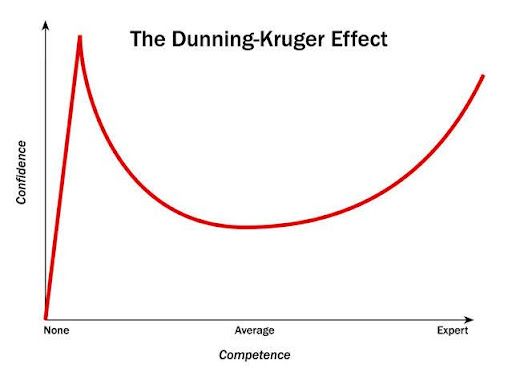
As people start learning about a subject, they realize that they have overestimated their competence in said subject. When that person starts to gain expertise, their confidence rises once more.
Originating from Cold-War Propaganda, this fallacy claims that the other side is somehow able to easily persuade people into their “evil” ideology. Historically, brainwashing has been a practice done via torture or manipulation to get someone, typically a prisoner, to believe an ideology they originally opposed. In this fallacy, however, the speaker claims that the opposing side is somehow able to brainwash people without these methods of torture. An example of this would be if someone were to accuse, “The internet brainwashed you into thinking that evolution is real!”
A Straw Man argument is when a person significantly oversimplifies their opponent’s arguments, presenting it as a ridiculous viewpoint, and then attacks their own extreme version of the argument. Although this may seem obvious to spot, it is used often and works effectively. A common use of this fallacy in modern politics is when one reduces anti-book banning arguments as wanting to “expose children to pornography,” and attack that insultingly exaggerated version of the argument.
This fallacy is a common one, and those who use it tend to take a moral or intellectual “high horse.” In effect, this fallacy is used to claim that, because “all” politicians are inherently corrupt, there is no point in meaningfully engaging in politics. For example, one might say, “I’m not going to vote. Both sides are bad, so I will not vote for either of them.” [Read: “I will not engage in a corrupt government, but I will do nothing to change it.”] Although this may seem to be a sound statement, ignoring all politics because one believes that all politicians are corrupt only leaves those who are corrupt to engage in politics, causing the opposite of the intended effect.
Based on logos, circular reasoning supports an argument by restating it, rather than presenting evidence, such as “Roller coasters are dangerous because they present risks.” In this example, the speaker does not provide further evidence as to why roller coasters are dangerous, but rather rephrases their original statement. This fallacy can also refer to an argument of “A is true because of B, and B is true because of A.” For example, “A triangle is a rectangle because a rectangle is a triangle.”
Tone Policing is often presented as a valid and sound critique of one’s opponent, when it is rarely relevant to the argument. Tone Policing is a pathos directed argument which disregards the opponent’s arguments as “invalid” because they deliver it with too much emotion or lack thereof, such as accusing someone of murder because they acted cold or disregarding a valid argument from someone because they are crying. This fallacy is often used against protesters, and occasionally has sexist implications, downplaying a woman’s argument as “purely emotional.”
Learning about logical fallacies can be useful when engaging with literature and politics, and it is
important to learn the practical use of finding logical fallacies.
A fallacy does not necessarily invalidate an argument, but fallacies must come into question if used constantly. An accidental use of a fallacy in an argument may not be significant, but an argument solely built on fallacies is a weak one, and it must be recognized and treated as such.
Furthermore, recognizing fallacies in one’s own arguments and way of thinking is an important step to grow in their intellect and evaluate their beliefs.